
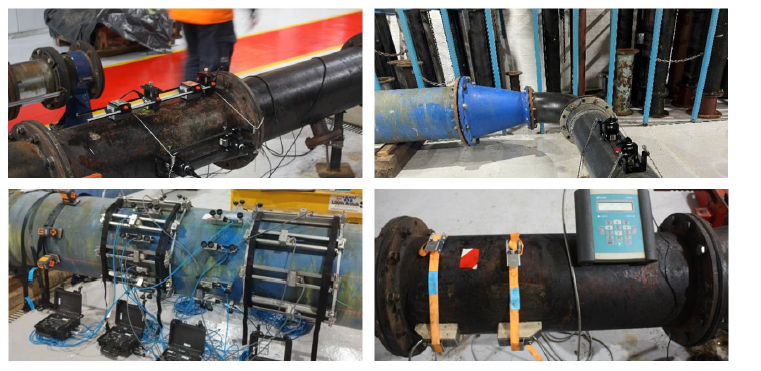
Realistic Ultrasonic Meter Accuracy: New 2026 Findings on Clamp-On Ultrasonic Flow Meter Verification
A new technical investigation published in January 2026, titled “Realistic Ultrasonic Meter Accuracy – An Investigation into the Realistic Accuracy that can be Achieved Using Clamp-On Ultrasonic Meters for Meter Verification in the Water Industry”, provides important insights into the actual performance and limitations of clamp-on ultrasonic flow meters used for meter verification within water utilities.
The study addresses a critical issue faced by many operators worldwide: how reliable are portable clamp-on ultrasonic meters when used to verify the accuracy of existing production, district, or customer meters in real operational conditions?
Clamp-on ultrasonic technology has become increasingly popular in recent years due to its non-invasive installation, rapid deployment, and ability to perform flow measurements without interrupting water supply. Utilities frequently use these devices for temporary flow monitoring, DMA investigations, bulk meter validation, leakage studies, and verification of permanent metering installations.
However, while manufacturers often specify high laboratory accuracies under ideal hydraulic conditions, the new investigation highlights that field conditions inside operational water networks are significantly more complex.
The report emphasizes that realistic accuracy depends on multiple factors, including:
- pipe material and wall condition;
- internal pipe scaling and deposits;
- flow profile disturbances;
- upstream and downstream pipe configurations;
- sensor positioning quality;
- air entrainment;
- water temperature variations;
- hydraulic turbulence and transient conditions.
One of the key conclusions of the investigation is that achieving laboratory-level accuracy in the field is rarely possible. Instead, operators should adopt a “realistic operational accuracy” approach, understanding that uncertainty margins increase considerably in live network environments.
The study also underlines the importance of operator experience and installation methodology. Even high-end ultrasonic devices can produce unreliable results if installation procedures are not carefully followed or if the hydraulic conditions are unsuitable for stable ultrasonic signal transmission.
For water utilities working on NRW (Non-Revenue Water) reduction programs, DMA analysis, and meter verification campaigns, the findings are highly relevant. Clamp-on ultrasonic meters remain extremely valuable operational tools, particularly because they allow rapid diagnostics without excavation or service interruption. However, the report recommends that utilities should:
- establish realistic expectations regarding achievable accuracy;
- verify hydraulic suitability before testing;
- use multiple measurements when possible;
- combine ultrasonic verification with pressure and consumption analysis;
- document uncertainty ranges during audits and investigations;
- ensure proper technician training and competency.
The publication also reinforces the broader industry trend toward data-driven operational decision-making. As utilities continue investing in digital monitoring, smart metering, and advanced NRW reduction strategies, understanding the limitations and uncertainty of measurement technologies becomes increasingly important.
In practical terms, the investigation helps utilities avoid overconfidence in temporary verification measurements and encourages a more balanced engineering approach when interpreting flow data collected using portable ultrasonic equipment.
For professionals involved in water loss management, DMA monitoring, production metering, and calibration verification, the January 2026 findings provide valuable guidance on how clamp-on ultrasonic technology should realistically be applied in modern water distribution systems.


Leave A Comment